Your 30-Day PMP Study Plan Using Mock Exams (Built for Busy Professionals)

Gulab Chand Tejwani
PMP · PL-300 · Microsoft Certified Trainer
· 5 min read

A 30-day PMP study plan works if you already know the basics and use the month to turn that knowledge into consistent exam performance. The structure is: take a baseline mock on day one, spend weeks one to three on the People, Process and Business Environment domains while reviewing every mock in detail, start timed full-length exams from week two, and use the last week for exam-day rehearsal and rest. If you're starting from zero, stretch the same plan over six to eight weeks.
This is the plan I suggest to working professionals in our PMP batches who have finished their 35 contact hours and have an hour or two a day. It isn't a guarantee. Your starting point and how carefully you review will decide how well it works.
What's the one rule behind this plan?
Practise full-length, review honestly, repeat. Everything below is just a timetable for that. Your mock score report shows where your judgement is weak, so you spend time on gaps instead of re-reading what you already know. If you haven't used one before, read how to read a PMP score report first.
Week 1: baseline and the People domain
- Day 1: Take a full-length mock, untimed. The score doesn't matter yet. You need an honest starting point.
- Days 2 to 3: Review every question, including the ones you got right. Note the domain and the principle each one tested.
- Days 4 to 7: Focus on People, which is 33% of the exam since July 2026: conflict, team performance, stakeholder engagement and servant leadership. Do two or three more practice sets and keep reviewing.
People questions are where technically strong candidates often lose marks, which is why the plan starts there.
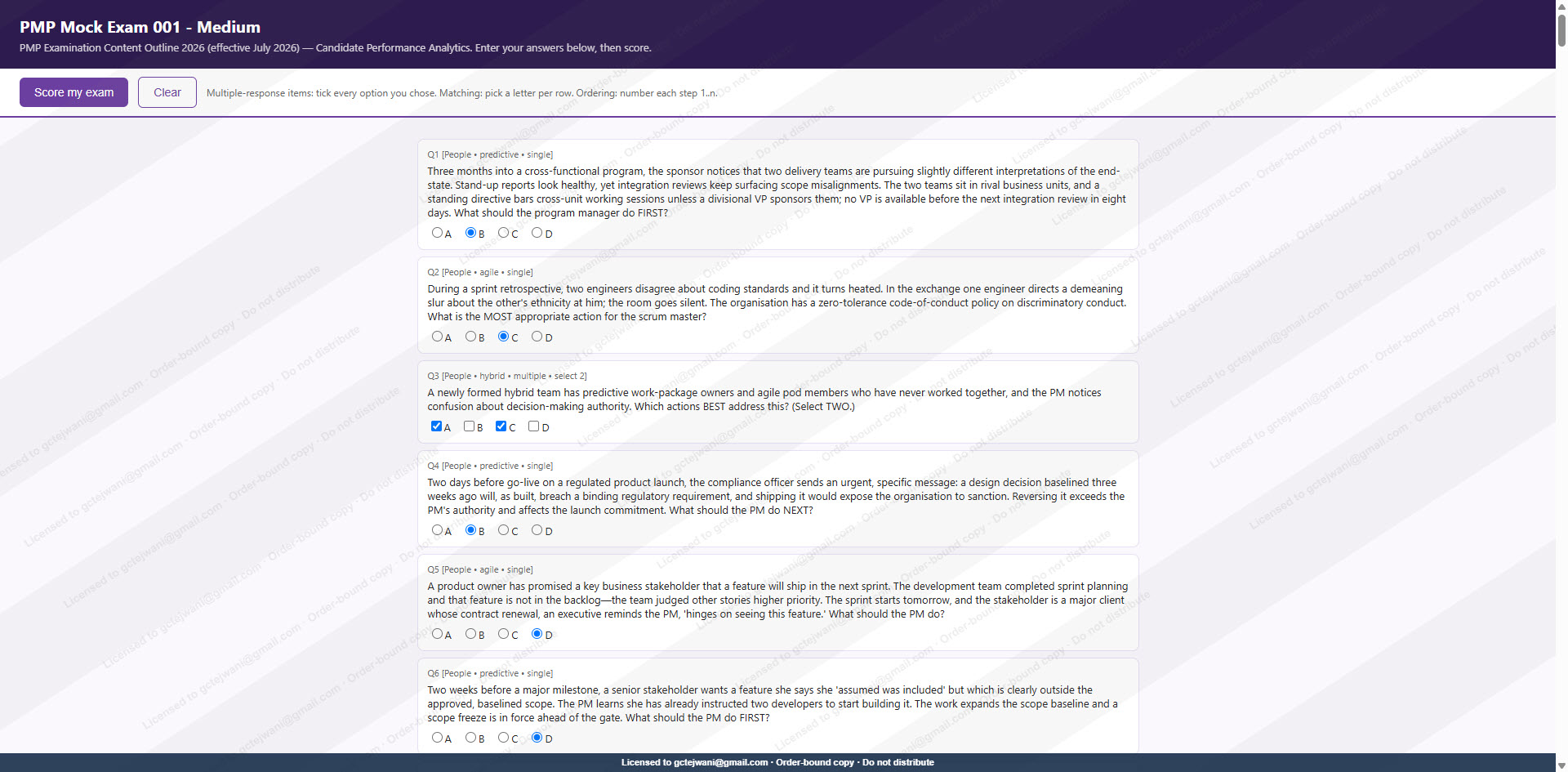
Week 2: Process domain and stamina
- Days 8 to 11: Move to Process, 41% of the exam. Practise predictive, agile and hybrid scenarios, because the exam mixes all three (see our agile vs predictive vs hybrid guide).
- Days 12 to 14: Start timed full-length mocks in one sitting. The real exam is 180 questions in 240 minutes, and stamina is a skill you have to train.
Keep a running list of repeated mistakes and the principle behind each one. The patterns tell you what to fix.
Week 3: Business Environment and weak areas
- Days 15 to 17: Give Business Environment proper time. At 26% of the exam it's no longer the small slice it was before July 2026. Cover value delivery, governance, compliance, organisational change, sustainability and how AI is used on projects.
- Days 18 to 21: Use your score reports to pick your two weakest areas and drill them. Alternate timed full mocks with review days.
By the end of week three your scores should be steadier.
Week 4: rehearse exam day and taper
- Days 22 to 27: Take full-length, timed mocks under exam-like conditions: quiet room, no phone, only the scheduled breaks. Review only what you got wrong.
- Days 28 to 29: Light review of your error log. Nothing new.
- Day 30: Rest. A rested brain is worth more than a last evening of cramming. Our exam-day checklist covers the logistics.
How many questions does this plan involve?
It depends on how many full mocks you take and how much drilling you add. Many candidates feel ready somewhere between 1,500 and 4,000 questions reviewed properly. The aim is consistent scores across all domains and comfortable timing, not a count. More on this in how many PMP practice questions you need.
How do you adapt the plan to your schedule?
- Less time each day? Stretch it to six or eight weeks in the same order.
- Strong in People, weak in Process? Shift the weeks towards your actual gaps.
- Scores still jumping around in week four? Move the exam date if you can. Steady scores across domains are a better signal than the calendar.
Why rehearse with full-length mocks at all?
A PMP attempt costs a real fee and weeks of effort. Candidates who prepare only by reading often feel ready until the length and ambiguity of the real exam catch them out. Full-length mocks are dress rehearsals, so the format no longer surprises you on the day.
Start your 30 days
TechNet Consultancy's PMP materials are independent and not affiliated with PMI. No mock exam guarantees a pass, but a good one tells you clearly where you stand.
Day 1 baseline, free. Download a complete PMP mock exam with an interactive score report →.
Enough material for the whole month. 35 full-length PMP mock exams (6,300+ questions) → with explanations, domain analytics, and access for the period shown on the package.
Prefer the browser? Start with a free PMP mock test online →.
For the full route from eligibility to exam day, see how to prepare for the PMP exam, step by step.
FAQ
Can I pass the PMP with 30 days of study?
Many candidates do, if they have already completed their 35 contact hours and understand the fundamentals. If you're starting from scratch, plan for six to eight weeks or more.
How many hours a day should I study for the PMP?
For this plan, one to two focused hours on weekdays and longer sessions at weekends for full-length mocks works for most working professionals.
When should I take my first full-length PMP mock?
On day one, as a baseline. Then move to timed full-length mocks from the second week.
How much time should I spend on Business Environment in 2026?
More than before. It is 26% of the exam since July 2026, so it deserves roughly a quarter of your practice.
What should I do the day before the PMP exam?
Light review only, check your exam logistics, and sleep well. Avoid taking a full mock the day before.