Agile vs Predictive vs Hybrid on the PMP Exam: What You Must Know

Gulab Chand Tejwani
PMP · PL-300 · Microsoft Certified Trainer
· 5 min read

Predictive (waterfall) projects plan scope, schedule and budget up front and control changes against a baseline. Agile projects deliver in short iterations and expect requirements to change. Hybrid projects combine the two. On the PMP exam, about 40% of content reflects predictive approaches and 60% agile or hybrid, so you need to recognise which approach a question assumes and answer in the way that fits it.
This is the topic that surprises experienced managers most in our PMP classes. Someone with fifteen years of construction or infrastructure projects can still lose a lot of marks if they answer every question as though a change control board is always the right move.
What are predictive, agile and hybrid approaches?
Predictive, often called waterfall, plans the work in detail first and then executes in sequence. Scope, schedule and cost are baselined early and changes go through formal control. It suits work with stable, well-understood requirements: construction, regulated manufacturing, a migration with fixed specifications.
Agile, or adaptive, delivers in short iterations with frequent feedback. Requirements are expected to evolve. The team works from a prioritised backlog and values working outcomes and collaboration over heavy upfront documents. It suits work where the problem or solution is uncertain, which is common in software and product development.
Hybrid deliberately mixes the two. A fixed regulatory milestone or hardware order might be planned predictively while the user-facing features are built iteratively. Most real organisations work this way.
Why does the PMP exam test agile and hybrid so heavily?
PMI's July 2026 Examination Content Outline places roughly 60% of the exam in agile or hybrid contexts. The exam isn't testing whether you can recite one methodology. It tests whether you can pick and apply the right approach for the situation. So you'll see backlogs, iterations, retrospectives and product owners right next to baselines and risk registers. Our 2026 exam pattern guide has the full breakdown.
How does the exam test this?
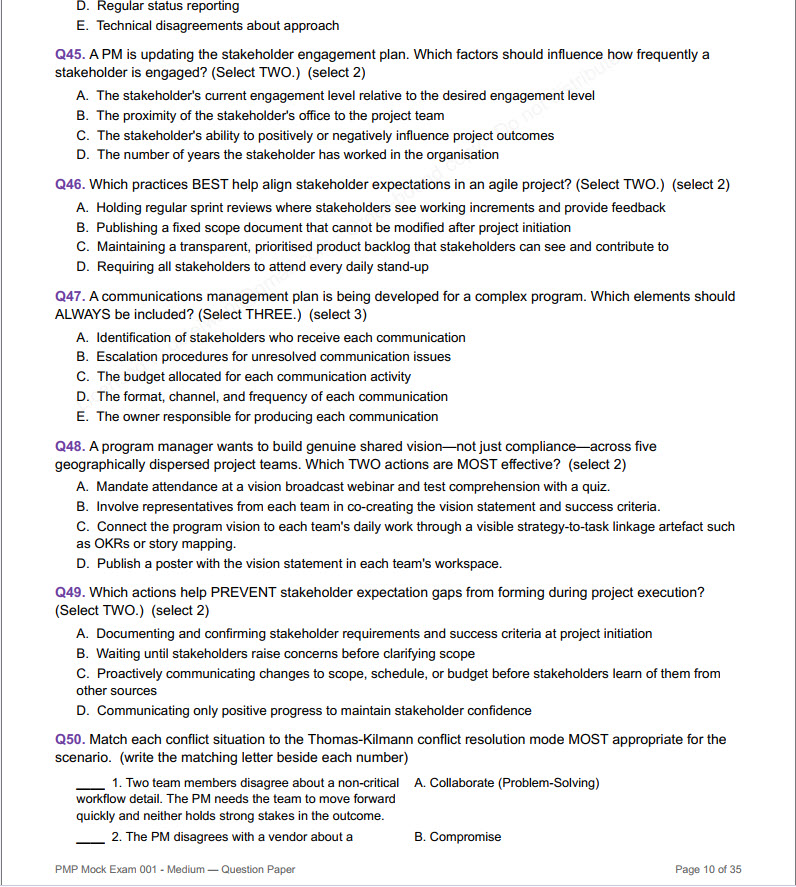
Questions rarely ask "define agile". They describe a scenario and ask for the best action, and the right answer depends on the approach in play:
- In an agile scenario, the best answer usually empowers the team, accepts change through the backlog and favours collaboration. Sending a change to a formal board is often wrong here.
- In a predictive scenario, the best answer usually respects the baseline and the change control process. Quietly absorbing a scope change is often wrong here.
- In a hybrid scenario, first work out which part of the project the question is about.
How can you tell which approach a question assumes?
Scan for clues before you read the options:
- Agile clues: sprint, iteration, backlog, product owner, retrospective, increment, evolving requirements, frequent customer feedback.
- Predictive clues: baseline, change control board, detailed plan, fixed scope, phase gate, formal sign-off.
- Hybrid clues: a mix, such as a fixed compliance date alongside iterative delivery, or "one part of the project uses".
The PMI mindset applies on top of all three: support the team, talk to people directly, prevent problems early and protect the delivery of value. Only the mechanics change.
Which agile concepts should you know well?
You don't need to be a certified Scrum Master, but these should feel natural:
- iterations, increments and delivering value early,
- backlogs, prioritisation and the product owner role,
- servant leadership: removing impediments rather than directing,
- retrospectives and continuous improvement,
- adapting to change rather than resisting it,
- how hybrid connects predictive planning with adaptive delivery.
What's the risk of skipping agile and hybrid prep?
Candidates who prepare only for traditional project management often feel confident until a long run of agile and hybrid scenarios appears. With most of the exam in those contexts, that is an expensive blind spot. The fix is plenty of mixed scenario practice with careful review, so the adaptive questions stop feeling foreign. Our free PMP practice questions are a good place to start, and our 30-day study plan builds this in from week two.
Practise across all three approaches
TechNet Consultancy's PMP materials are independent and not affiliated with PMI, and no practice resource guarantees a pass. You can check the question style for free.
See the mix, free. Download a complete PMP mock exam → with predictive, agile and hybrid scenarios and full explanations.
Full coverage. 35 full-length PMP mock exams (6,300+ questions) → with explanations, analytics and access for the period shown on the package.
Timed practice online. Try agile and hybrid scenarios in a timed PMP mock test →.
FAQ
How much of the PMP exam is agile?
PMI's 2026 outline places roughly 60% of the exam in agile or hybrid contexts and about 40% in predictive.
Is waterfall still tested on the PMP?
Yes. Predictive (waterfall) approaches make up roughly 40% of the content, and many hybrid questions include predictive elements.
Do I need an agile certification before the PMP?
No. The PMP doesn't require one. You need to understand agile concepts well enough to apply them in scenarios.
What is a hybrid project?
A project that deliberately combines predictive and adaptive approaches, for example fixed planning for regulatory milestones with iterative delivery for features.
What does servant leadership mean on the PMP exam?
It means the project manager supports the team by removing obstacles, coaching and enabling self-organisation, rather than directing every task.