How Many PMP Practice Questions Do You Really Need to Pass? (2026 Guide)

Gulab Chand Tejwani
PMP · PL-300 · Microsoft Certified Trainer
· 6 min read

There is no fixed number of PMP practice questions that guarantees a pass. Many candidates feel ready somewhere between 1,500 and 4,000 well-reviewed questions, but the better test is this: you score consistently across all three domains on full-length, timed mocks, and you can explain why each wrong answer was wrong. Volume without review doesn't move that needle.
I'm a PMP-certified trainer, and this is the question I hear most often in our PMP batches. People want a number because a number feels like a plan. Here is a more useful way to think about it.
Why does the PMP exam reward practice more than reading?
The exam rarely asks you to define a term. It puts you in a situation (an unhappy sponsor, a slipping sprint, two team members in conflict) and asks what you should do first or what the best response is. Often two or three options look sensible. Only one matches how PMI expects a project manager to think.
You can read the PMBOK Guide carefully and still find these questions hard, because the skill is judgement under time pressure. Practice questions train that judgement in a way reading can't.
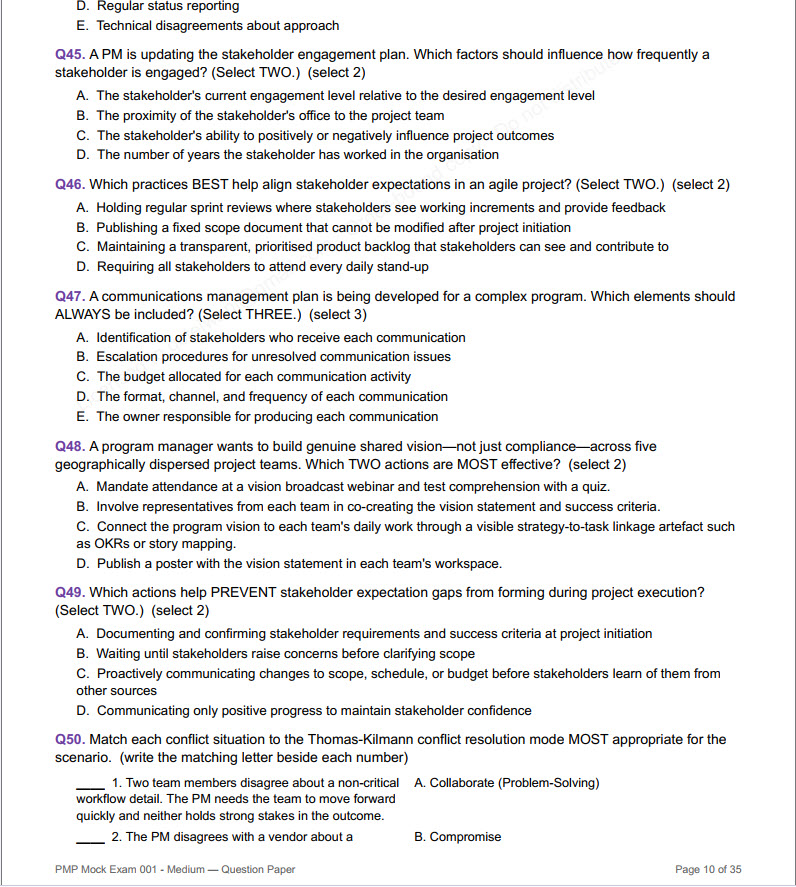
How many PMP practice questions are enough?
Your starting knowledge, your real project experience and how carefully you review all change the answer. Instead of a single figure, think in stages:
- Foundation, roughly 500 to 1,000 questions. You learn the format and get used to scenario wording.
- Building confidence, roughly 1,500 to 3,000. Patterns appear. You start seeing why the best answer is best, not just which one it is.
- Exam readiness, roughly 3,000 to 5,000. Scores stabilise, pacing improves and your weak domains catch up.
- Over-preparing on purpose, 6,000 and above. For people who would rather see every style of question than wonder on exam day.
These are ranges, not promises. Some people are ready earlier. Some need more.
Why does volume only work with honest review?
Doing thousands of questions changes nothing if you don't learn from the mistakes. Rushing through just makes you repeat the same errors faster.
After every practice set, go through each question and ask:
- Why was my answer wrong?
- Why was the correct answer better?
- Which domain and which principle was this really testing?
One wrong answer that you understand deeply teaches more than ten you skimmed. This is also why explanations matter as much as question count. A good mock exam explains the reasoning, so each question leaves you with something reusable.
Why isn't one mock exam enough?
A single full-length mock gives you a snapshot. Since 9 July 2026 the PMP exam has 180 questions (170 scored and 10 unscored pretest items) in 240 minutes. That is four hours of concentration. Reading slows down, attention drifts, and small mistakes creep in near the end.
Taking several full-length, timed mocks trains stamina and pacing, not only knowledge. By the third or fourth, the length stops being a shock.
What does it cost to be under-prepared?
A PMP attempt costs a real exam fee, plus the weeks you spent studying. Candidates who rely on reading alone often find the real exam feels different from what they expected: the wording, the ambiguity, the pace. A retake means another fee and more weeks before you're certified.
Mock exams exist to close that gap while you still have time. Treat them as rehearsals rather than extra homework.
How do you know you're ready for the PMP exam?
Swap "have I done enough questions?" for these:
- Am I scoring consistently across People, Process and Business Environment, not just my favourite domain?
- Can I finish a full 180-question mock inside the time limit without rushing the last 30?
- When I miss a question, can I usually explain why, and would I get a similar one right next time?
- Do scenario questions feel familiar rather than unsettling?
If the answer is yes on several recent mocks, you're ready, whether that took 2,000 questions or 5,000.
What's a simple way to practise?
- Take one full mock untimed to set an honest baseline.
- Review every explanation, including questions you got right (you may have guessed).
- Find your two weakest domains and drill them.
- Switch to timed, full-length mocks to build stamina.
- Repeat until your scores are steady and the clock feels comfortable.
If you want to try a few first, start with our free PMP practice questions. A day-by-day version of this is in our 30-day PMP study plan, and our guide on reading your score report shows how to turn results into a study list.
Where can you get realistic practice?
TechNet Consultancy's PMP materials are independent and not affiliated with or endorsed by PMI. No practice resource can guarantee a pass, ours included. What we can do is let you check the standard first.
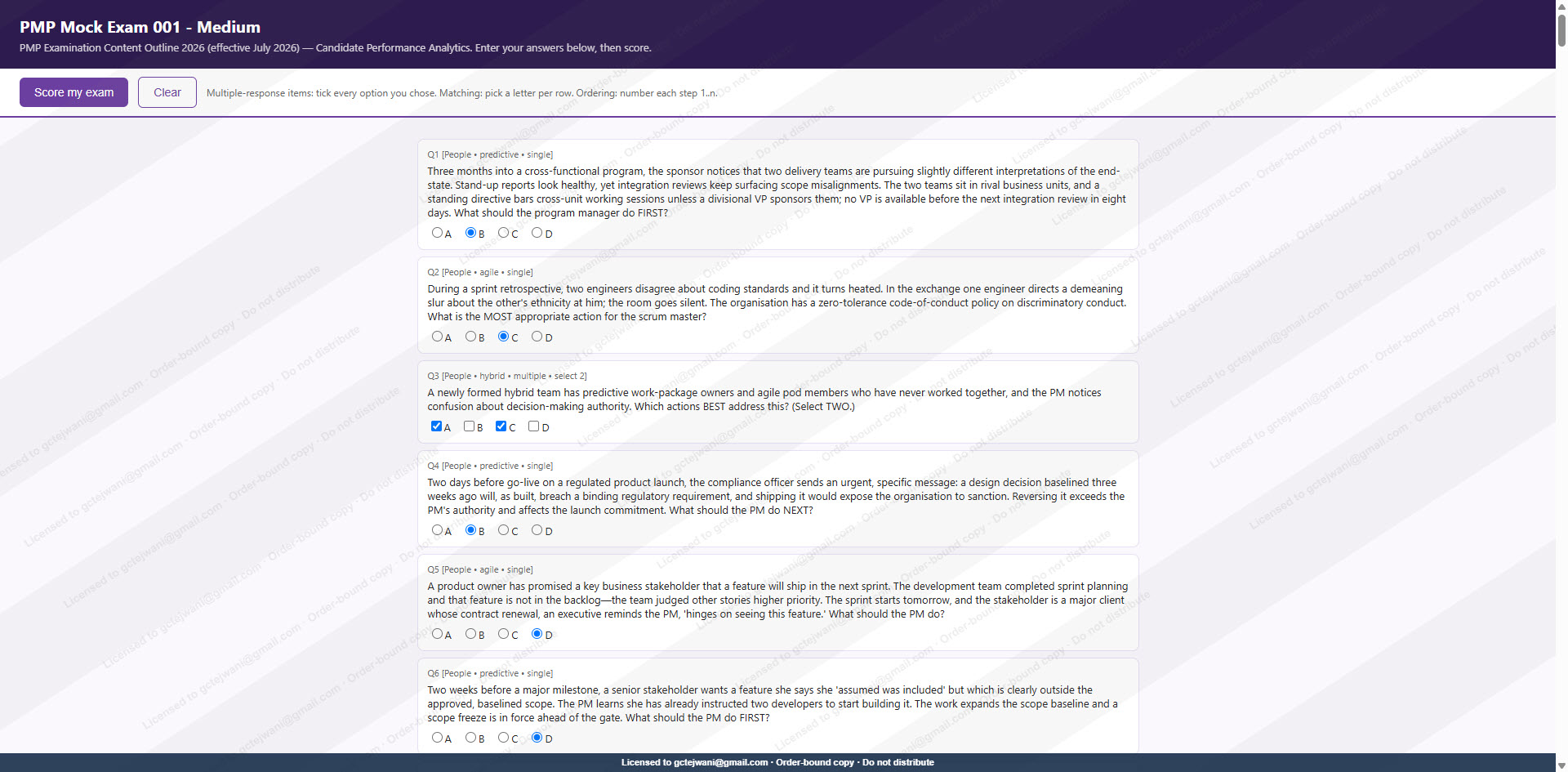
Try one free. Download a complete PMP mock exam at no cost →. It is a full 180-question paper with explanations and an interactive score report.
Need more volume? 35 full-length PMP mock exams (6,300+ questions) → with explanations, domain-wise analytics, and access for the period shown on the package.
Prefer the browser? Explore our PMP mock exams online → for timed attempts.
FAQ
How many PMP practice questions should I do?
Most candidates do somewhere between 1,500 and 4,000 with careful review, but readiness is better measured by consistent scores across all domains on timed full-length mocks than by a question count.
How many full-length PMP mock exams should I take?
Several. Many candidates take four to eight timed, full-length mocks in the final weeks so that the four-hour format feels routine.
What score on a PMP mock exam means I'm ready?
Mock scoring varies between providers, so compare against the provider's own guidance. A common rule of thumb is steady scores around 75 to 80 percent or higher across all domains on several recent mocks.
Is it better to do more questions or review them more carefully?
Review matters more. Questions you skip reviewing teach very little, so fewer questions reviewed well usually beats more questions done quickly.
How long is the PMP exam in 2026?
Since 9 July 2026 the PMP exam has 180 questions (170 scored, 10 unscored) with 240 minutes of exam time.