How to Read Your PMP Mock Exam Score Report (and Actually Act on It)

TechNet Consultancy
7/19/2026
#PMP#PMP Score Report#PMP Mock Exam#PMP Exam Preparation#Project Management

Most PMP candidates glance at a mock exam score, feel briefly good or bad about it, and move on. That's a waste — because the score itself is the least useful part of the report. The real value is in what the report tells you about where your judgement is strong and where it's leaking points.
A good PMP mock exam score report is a diagnostic tool. Read properly, it tells you exactly what to study next. Read carelessly, it's just a mood. This guide shows you how to read your score report like a coach reads game film — and how to turn it into a focused, efficient study plan.
The number is the start, not the verdict
First, a mindset reset. A single mock score is a snapshot under specific conditions, not a prediction etched in stone. One low score after a tiring day doesn't mean you'll fail; one high score on a familiar paper doesn't mean you're ready. What matters is the trend across several full-length mocks and the pattern within each one.
So when you open a score report, resist the urge to judge yourself by the headline percentage. Instead, treat it as data you're about to mine.
Understanding performance bands
The real PMP exam doesn't give you a percentage — it reports performance in bands, typically described as Above Target, Target, Below Target (and sometimes Needs Improvement), broken down by domain. Good mock exams mirror this, often alongside a percentage so you can track movement.
Here's how to interpret the bands per domain:
- Above Target: this domain is a genuine strength. Maintain it with light, occasional practice — don't over-invest here.
- Target: solid, but not bulletproof. Keep practising; this is where a bad day can slip you backwards.
- Below Target / Needs Improvement: this is where your points are leaking. This is your priority, even though it's the least comfortable area to study.
The instinctive mistake is to keep practising your Above Target domains because it feels good. The effective move is the opposite: pour your energy into Below Target areas, because that's where the fastest score gains hide.
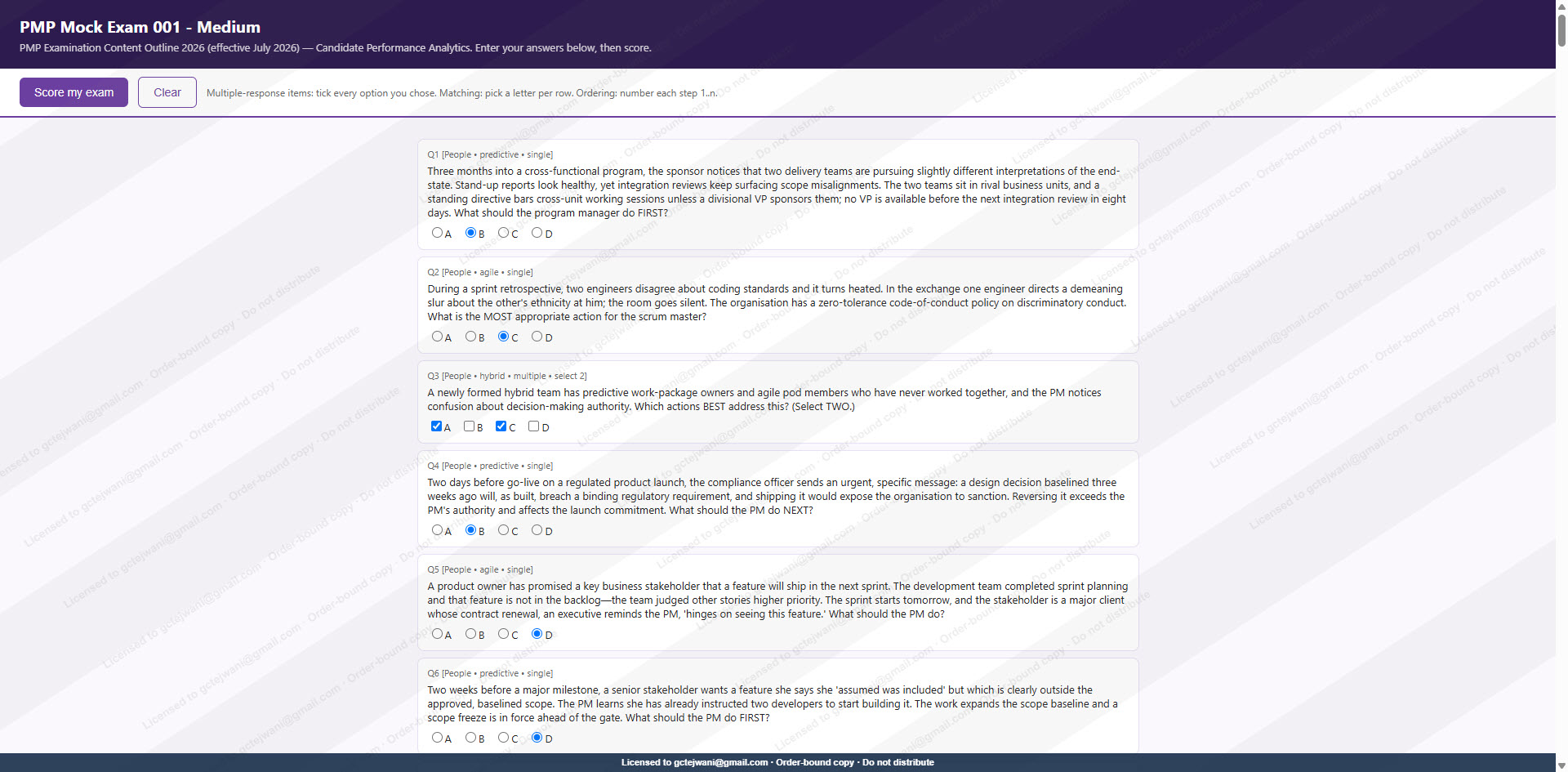
Read it domain by domain
The PMP exam spans three domains, and your report should break performance down across them:
- People (~42% of the exam): leadership, conflict, team performance, stakeholders. Many technically strong candidates quietly underperform here.
- Process (~50%): the technical execution across predictive, agile, and hybrid.
- Business Environment (~8%): compliance, organisational value, external factors.
Look at your bands against these weightings. A Below Target in People or Process is far more damaging than one in the small Business Environment slice, simply because those domains carry most of the questions. Prioritise repairs where the exam concentrates its marks.
Look past the score to the patterns
The most valuable review happens below the headline numbers, in the question-by-question detail. As you go through, hunt for patterns rather than individual mistakes:
- Topic clusters: Are your misses bunched around a theme — risk, procurement, agile ceremonies, conflict resolution? A cluster points straight at a study target.
- Approach confusion: Do you get predictive questions right but stumble on agile or hybrid ones (or vice versa)? That reveals an approach you haven't internalised.
- Question type: Do "what would you do first?" questions trip you up more than knowledge questions? That's a PMI-mindset gap, not a content gap.
- Lucky guesses: Mark questions you got right but weren't sure about. A correct guess hides a real weakness — review those as if you'd got them wrong.
- Timing: Did accuracy fall in the final third? That's a stamina or pacing issue, not a knowledge one.
Each pattern suggests a different fix. The score can't tell you any of this; the detail can.
Turn the report into a study plan
Here's a simple loop to convert every score report into action:
- Identify your weakest domain from the bands. That's your headline focus for the next few days.
- Within it, find the topic cluster causing the most misses. Study that specifically.
- Re-read the rationales for every wrong answer (and every uncertain right answer), writing down the principle each one tested.
- Drill that weak area with focused questions.
- Take another full-length mock and check whether that domain's band improved. Then repeat with the next weakest area.
This is targeted practice, and it moves your score far faster than simply doing more random questions. You're treating the score report as a map, and walking straight to the gaps.
Track the trend, not the mood
Finally, keep a simple log across mocks: date, overall result, and the band for each domain. Over a few weeks you want to see Below Target domains climbing to Target, and Target domains stabilising at the top. That trend — steady improvement across all domains — is a far better readiness signal than any single high score.
You're ready not when you hit a magic number once, but when your report shows consistent strength across People, Process, and Business Environment, with comfortable timing.
Why the quality of the report matters
All of this depends on having a score report worth reading. A bare "you scored 72%" tells you almost nothing. What you need is a report that breaks performance down by domain, flags your weak areas, and pairs every question with a clear explanation of the reasoning. That feedback is what turns practice into progress.
See a real score report for yourself — free. Download a complete PMP mock exam with an interactive score report → and practise reading your own results.
Want domain-wise analytics across many exams? Get 35 full-length PMP mock exams (6,300+ questions) → — each with detailed explanations and performance analytics, plus lifetime access, so you can track your trend all the way to exam-ready.
See domain bands on a live attempt. Take a free timed mock with an interactive score report →.
Your score is just the headline. The story — and your study plan — is in the domains, the patterns, and the trend. Learn to read your PMP score report properly, act on what it shows, and every mock you take becomes a step forward instead of just a number.