PMP Exam-Day Checklist: What to Expect and How to Stay Calm
TechNet Consultancy
7/22/2026
#PMP#PMP Exam Day#PMP Exam Preparation#PMP Certification#Project Management

You've studied for weeks, your mock scores are consistent, and the exam is booked. Now there's one last variable to manage: exam day itself. A surprising number of well-prepared candidates lose easy points not because they didn't know the material, but because the logistics, the format, or the nerves caught them off guard.
This is a practical PMP exam-day checklist. It covers what to expect whether you test at a centre or online, what to bring, how the format and breaks work, and how to keep a clear head across a long, demanding exam. Treat it as the final piece of your preparation — the part that makes sure your knowledge actually shows up on the day.
First, know the format cold
The PMP exam is 180 questions in 230 minutes, with two scheduled 10-minute breaks (after roughly the first and second thirds). Question types include multiple choice, multiple response (select more than one), matching, hotspot, and limited fill-in-the-blank. Most are scenario-based: you're given a situation and asked for the best action.
Knowing this in advance removes a whole category of surprise. By exam day, the format should feel routine — which is exactly why taking several full-length, timed mocks beforehand pays off. The first time you experience the length and pacing of the exam should never be the real thing.
Choose your setting: test centre vs online
You can sit the PMP either at a Pearson VUE test centre or as an online proctored exam from home. Both are valid; pick the one that suits you.
Test centre:
- You travel to a quiet, controlled environment with a provided computer.
- Lockers are available for your belongings.
- Plan your route and arrive early — aim to be there about 30 minutes before your slot.
Online proctored (from home):
- You need a quiet, private room, a stable internet connection, a webcam, and a clear desk.
- You'll do a system check and a room scan before starting; a proctor monitors you throughout.
- No one else may enter the room, and your desk must be clear of notes and devices.
If you choose the online option, run the system/equipment check well before exam day so any technical issue is sorted in advance, not in the stressful final minutes.
What to bring (and what you can't)
For a test centre, bring:
- Valid, government-issued photo ID (the name must match your PMI registration exactly)
- Your exam confirmation details
- Nothing else into the exam room — personal items go in a locker
For an online exam, have ready:
- The same valid photo ID for verification
- A clear desk and private room
- Water in a clear container (if permitted) — check the current rules
In both cases, you generally cannot bring your own notes, phone, smartwatch, or scratch paper into the exam; the system provides an on-screen or supplied way to make notes. Always confirm the latest rules in your confirmation email, since policies are updated periodically.
The night before and the morning of
The temptation is to cram. Resist it. The night before, do only light review and then stop.
- Sleep matters more than a few extra hours of study. A rested brain manages a 230-minute exam far better than a tired, crammed one.
- Prepare your logistics the night before: ID ready, route planned (or room cleared and equipment checked for online).
- Eat a proper meal beforehand and hydrate sensibly.
- Arrive (or log in) early so you're not starting in a rush.
You've done the work. The morning of the exam is about arriving calm, not learning anything new.
During the exam: pacing and the breaks
With 180 questions in 230 minutes, you have a little under 80 seconds per question on average. A few practical habits:
- Keep moving. If a question stumps you, make your best judgement, mark it for review, and move on. Don't let one hard question eat five minutes.
- Watch the section breaks. The two breaks come at set points; the clock pauses during them. Use them — stretch, breathe, reset. Skipping breaks to "save time" often backfires as fatigue builds.
- Read for the best answer, not just a right one. Several options may be technically acceptable; choose the one that reflects the PMI mindset — serving the team, communicating directly, preventing problems, protecting value.
- Use your review flags at the end if time allows, but don't second-guess every answer. First instincts, trained by practice, are usually sound.
Managing nerves (the calm comes from practice)
Some nerves are normal and even helpful. The goal is to keep them from tipping into the spiral where one unfamiliar question rattles you into doubting answers you actually know.
The single best antidote to exam anxiety isn't a breathing trick on the day — though slow breathing does help. It's familiarity built beforehand. When you've sat many full-length mocks under timed conditions, the real exam feels like one more rehearsal. The format is routine, the pacing is muscle memory, and your nervous energy turns into focus instead of panic.
So if you still feel shaky, the cure is the same as the study plan: more realistic, full-length practice before the day.
Your quick exam-day checklist
- Know the format: 180 questions, 230 minutes, two 10-minute breaks
- Setting confirmed: test centre route planned, or online room cleared + system checked
- Valid photo ID ready (name matches PMI registration)
- Good sleep the night before; no cramming
- Meal and hydration sorted; arrive/log in early
- Plan to pace yourself, use the breaks, and mark-and-move on hard questions
- Trust your preparation
Walk in rehearsed, not rattled
Exam day rewards the candidate who has already lived the experience in practice. Everything on this checklist is easier when the format holds no surprises.
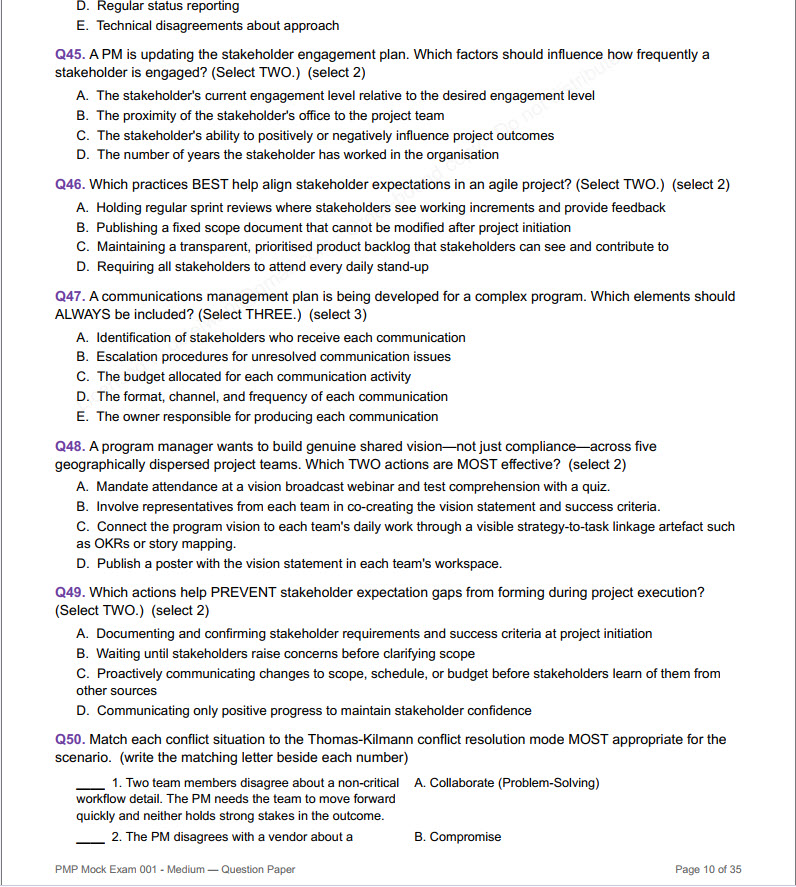
Rehearse the real thing — free. Download a complete PMP mock exam at no cost → — a full 180-question paper with detailed explanations and a score report, so exam day feels familiar.
Build true exam-day readiness. If your goal is to pass on the first attempt, practise under realistic conditions with 35 full-length PMP mock exams (6,300+ questions) → — detailed rationales, domain-wise analytics, and lifetime access.
Rehearse the clock before the real day. Run a timed PMP mock online → as part of your checklist.
Exam day is the easiest part to control if you prepare for it deliberately: know the format, sort your logistics, rest, pace yourself, and lean on the calm that comes from having rehearsed. Do the work in advance, and on the day you simply get to show what you already know.