Why You Keep Failing PMP Mock Exams (and How to Fix Each Reason)

Gulab Chand Tejwani
PMP · PL-300 · Microsoft Certified Trainer
· 6 min read

Most candidates who keep failing PMP mock exams don't have a knowledge problem. They have a practice problem: memorising instead of reasoning, skipping the explanations, taking too few full-length timed mocks, avoiding weak domains, cramming, and in 2026 still treating Business Environment as a minor topic. Fix how you practise and scores stuck in the 60s and low 70s usually start to climb.
I see this plateau in almost every PMP batch. A student knows the material, can explain a risk register in their sleep, and still lands at 68%. Below are the reasons I most often find, with what to do about each.
What is a PMP mock exam really for?
A mock is a diagnostic, not a grade. It shows where your judgement breaks down so you can fix it before the real exam. Treat each one as a verdict and you'll feel bad and learn little. Treat it as data and every wrong answer is useful.
1. Are you memorising instead of understanding?
The PMP rewards judgement. If you know processes and terms but freeze on "what should the project manager do first?", that's the bottleneck. For each practice question, say out loud why the best answer fits PMI's mindset: supporting the team, talking to people directly, preventing a problem rather than reacting to it.
2. Are you skipping the explanations?
Checking your score and jumping to the next mock wastes most of the value. The learning happens in the review. Read the explanation for every question, including the ones you got right. Some of those were guesses, and a 72% can hide several coin-flips you'll lose next time.
3. Are you taking too few full-length mocks?
Twenty questions on your phone between meetings is better than nothing, but it won't prepare you for 180 questions in 240 minutes. Stamina affects your score. Book time for complete, timed mocks in one sitting, the way you'll take the real exam.
4. Are you avoiding your weak domains?
Practising what you're good at feels nice and barely moves your overall score. Use a report that breaks results down by People, Process and Business Environment, pick the weakest one or two, and drill them. Our guide to reading a PMP score report shows how.
5. Are you cramming instead of spacing practice?
Long panicked sessions produce shallow recall that falls apart on a tricky scenario. Spread practice across weeks and come back to weak topics on a schedule. Steady practice beats occasional marathons.
6. Are you underestimating People or Business Environment?
People is 33% of the exam, and it's where many technically strong managers lose marks on conflict, motivation and stakeholder scenarios. Practise those specifically and get comfortable picking the supportive, team-first answer.
Business Environment is the newer trap. Since the exam update on 9 July 2026 it's 26% of the exam, up from 8%. If your materials or habits come from the old outline, you may be skipping a quarter of the exam. See the 2026 exam pattern.
7. Is it anxiety rather than knowledge?
Sometimes the first unfamiliar question rattles you, and by question 40 you're second-guessing answers you'd normally get right. Realistic full-length practice is also the best cure for this. By your tenth full mock, the format is routine and the nervous energy turns into focus.
What do all seven fixes have in common?
They come down to one habit: practise realistic, full-length questions, then review the reasoning honestly, especially in your weak domains. That review loop, not raw study hours, is what breaks a plateau. Good practice material helps, because it explains every option and shows you where you stand by domain.
What does it cost to ignore the plateau?
A PMP attempt costs a real fee and the weeks you've already invested. Sitting the exam while mock scores are still inconsistent is a gamble, and a retake means another fee and more study. The good news is that most people don't need to start over. They need to review more carefully, target weak domains and sit enough full mocks for their scores to settle.
A simple plan to break through
- Take one full-length, timed mock and treat the result as data.
- Review every answer and note the principle behind each miss.
- Pick your two weakest domains and drill them.
- Repeat timed full mocks until scores are consistent across domains.
- Ease off in the final days: light review and rest.
The 30-day PMP study plan turns this into a calendar, and our PMP practice test questions are a quick way to check your reasoning on each domain.
TechNet Consultancy's PMP materials are independent and not affiliated with PMI, and no practice resource can guarantee a pass.
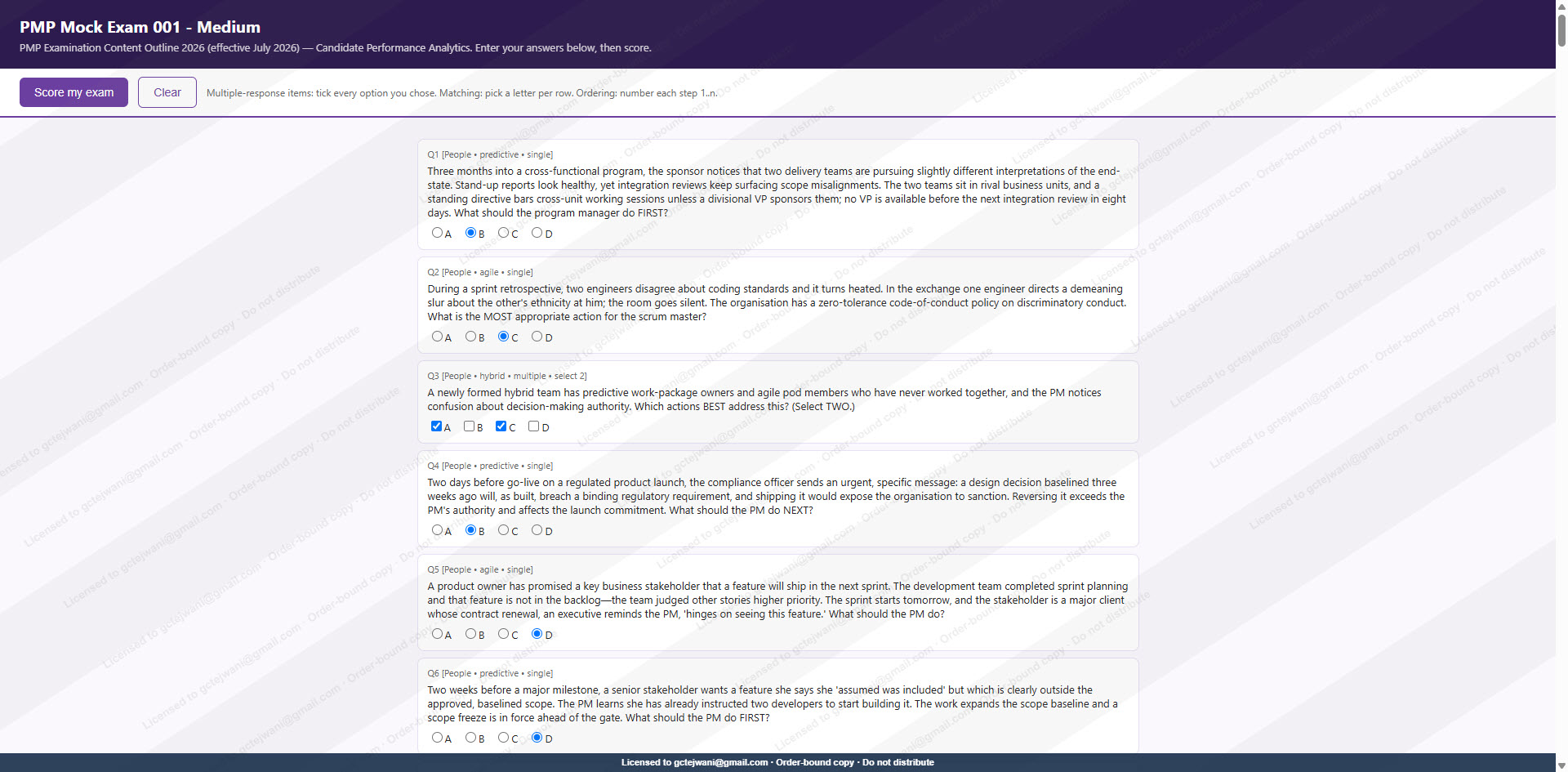
Diagnose your weak spots free. Download a complete PMP mock exam with an interactive score report →.
Build consistency. 35 full-length PMP mock exams (6,300+ questions) → with explanations, domain analytics, and access for the period shown on the package.
Rehearse the pace. Use a timed PMP mock test to simulate exam-day timing →.
FAQ
Why are my PMP mock scores stuck around 65 to 70 percent?
Usually because of practice habits rather than knowledge: not reviewing explanations, too few full-length mocks, avoiding weak domains, or answering from memory rather than PMI's mindset.
Are PMP mock exams harder than the real exam?
It depends on the provider. Use mocks mainly to find weak areas and build stamina, not to predict an exact score.
How long should I review a full-length mock?
Many candidates spend as long reviewing as they spent taking it. That review time is where most of the improvement comes from.
Should I postpone my PMP exam if my mock scores are low?
If your scores are still inconsistent across domains close to the exam date, moving the date is often cheaper than a retake.
Does the Business Environment domain matter more now?
Yes. Since 9 July 2026 it makes up 26% of the PMP exam, up from 8% under the previous outline.