Why You Keep Failing PMP Mock Exams (and How to Fix Each Reason)

TechNet Consultancy
7/1/2026
#PMP#PMP Mock Exam#PMP Practice Test#PMP Exam Preparation#Project Management

You've put in the hours. You understand the concepts. You can explain the difference between predictive and agile, you know your risk responses, and you've read the PMBOK® Guide. Yet your PMP mock exam scores keep landing in the 60s and low 70s — frustratingly close, but not quite at the level you need to feel confident booking the real thing.
If that sounds familiar, here's the encouraging part: this plateau is rarely a knowledge problem. It's almost always a handful of fixable habits in how you practise. Below are the most common reasons candidates stall on PMP practice tests, and a specific fix for each.
First, reframe what a mock exam is for
Before the list, one mindset shift. A PMP mock exam is not a grade. It's a diagnostic. Its job is to show you where your judgement breaks down so you can repair it before exam day. If you treat each mock as a pass/fail verdict, you'll feel discouraged and learn little. If you treat it as data, every "wrong" answer becomes a gift.
With that framing, let's look at what's actually holding your score back.
1. You're memorising instead of understanding
This is the most common cause by far. The PMP exam rewards judgement, not recall. If you've memorised processes, inputs, and outputs but freeze on "what would you do first?" questions, you've found your bottleneck.
The fix: for every practice question, force yourself to articulate why the best answer reflects the PMI mindset — usually something like serving the team, communicating directly, or preventing a problem rather than reacting to it. Train the reasoning, not the trivia.
2. You skip the explanation review
Many candidates check their score, sigh, and move on to the next mock. That's the single biggest wasted opportunity in PMP exam preparation. The learning doesn't happen during the question — it happens after, in the explanation.
The fix: review every answer, including the ones you got right. You may have guessed correctly, and a lucky guess hides a real gap. A score of 72% might contain several coin-flips you'll get wrong next time. Reviewing rights and wrongs turns a noisy score into reliable progress.
3. You take too few full-length exams
Doing 20 questions on your phone between meetings is better than nothing, but it doesn't prepare you for a 180-question, 230-minute marathon. Short bursts never build the stamina the real exam demands, and stamina is a genuine factor in your score.
The fix: schedule complete, timed mock exams. Sit them in one go, the way you'll sit the real exam. You're not just practising questions — you're training your brain to stay sharp into the final stretch, when fatigue quietly costs people points.
4. You avoid your weak domains
It feels good to practise what you're already good at. Your strong domain scores climb, and that's reassuring. But it doesn't move your overall result, because the exam tests all three domains and your weakest area is dragging you down.
The fix: use a score report that breaks results down by domain — People, Process, Business Environment. Identify your weakest one or two, and deliberately drill those, even though it's less comfortable. Targeted practice on weaknesses moves your score far faster than more practice on strengths.
5. You're cramming instead of spacing
Last-minute, marathon study sessions create anxiety and shallow recall. Information crammed in a panic rarely survives contact with a tricky scenario question.
The fix: spread your practice across weeks, revisiting weak topics on a schedule. Spaced, consistent practice builds durable recall and steadier nerves. Consistency genuinely beats intensity here.
6. You underestimate the People domain
The People domain is roughly 42% of the PMP exam, and it's where many technically strong project managers quietly lose points. Engineers and delivery-focused PMs often find conflict, motivation, and stakeholder scenarios less intuitive than schedule and scope questions.
The fix: practise People-domain scenarios specifically — team conflict, underperformance, stakeholder disagreements, servant leadership. Get comfortable choosing the empowering, people-first response, because the exam leans heavily in that direction.
7. You mistake test anxiety for lack of knowledge
Sometimes the issue isn't the material at all — it's that the first unfamiliar question rattles you, and the wobble compounds. By question 40 you're second-guessing answers you'd normally get right.
The fix: realistic, full-length practice is also the best cure for nerves. The more the mock experience resembles the real thing, the less intimidating exam day feels. Familiarity is calming. By your tenth full-length mock, the format is routine, and your nervous energy turns into focus.
The pattern behind all seven
Read those fixes again and you'll notice they point in the same direction: practise realistic, full-length questions, then review the reasoning honestly — especially for your weak domains. That review loop, not raw study hours, is what breaks the plateau.
It's also why the quality of your practice material matters. A good PMP exam simulator doesn't just mark you right or wrong; it explains the reasoning behind every option and shows you, domain by domain, where you stand. That feedback is what converts a stuck score into a rising one.
The cost of ignoring the plateau
It's worth being honest about the stakes. A PMP attempt costs real money, and behind it sits the time and energy you've already invested. Walking in while your mock scores are still inconsistent is a gamble — and a retake means another fee, more study, and a delayed certification.
The reassuring flip side: the plateau usually breaks faster than people expect once they change how they practise. Most candidates don't need to start over. They need to review more honestly, target their weak domains, and sit enough full-length exams to make their performance consistent.
A simple plan to break through
- Take one full-length, timed mock and treat the result as diagnostic data, not a verdict.
- Review every answer — rights and wrongs — and write down the principle behind each miss.
- Identify your two weakest domains from the score report and drill them deliberately.
- Repeat full-length, timed mocks until your scores are consistent across all domains.
- Taper in the final days: light review, rest, and trust your preparation.
Turn your plateau into a pass
If your scores have stalled, change how you practise before you add more hours. Realistic mocks with honest review are the fastest way through.
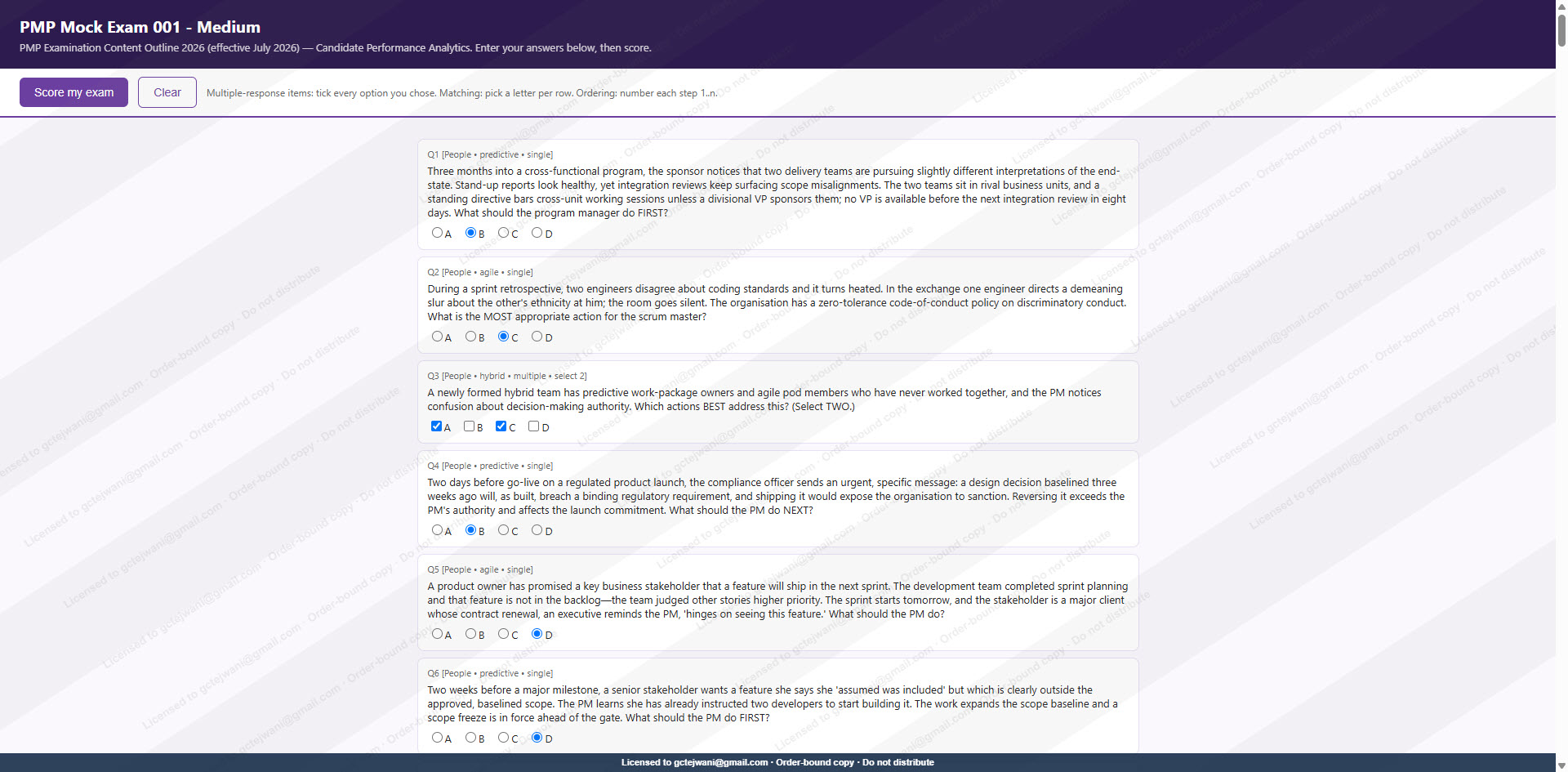
Diagnose your weak spots for free. Download a complete PMP mock exam with an interactive score report → — see exactly where you stand across People, Process, and Business Environment.
Ready to break the plateau for good? If your goal is to pass on the first attempt, build consistency with 35 full-length PMP mock exams (6,300+ realistic questions) → — detailed explanations, domain-wise analytics to target your weaknesses, and lifetime access.
A stuck score isn't a sign you can't pass. It's a sign your practice method needs a small upgrade. Fix how you practise, target your weak domains, and the 60s and 70s tend to become the 80s sooner than you'd think.