PMP Exam Pattern 2026: The ECO Explained (and How to Prepare for It)
TechNet Consultancy
6/28/2026
#PMP#ECO 2026#PMP Exam Pattern#PMP Exam Preparation#Project Management

If you're planning to take the PMP exam, one of the most useful things you can do early is understand how the exam is actually structured. Not the rumours, not the outdated forum threads — the official blueprint. That blueprint is the PMP Exam Content Outline (ECO), and aligning your PMP exam preparation to the current ECO is one of the simplest ways to study efficiently instead of wastefully.
This guide breaks down the 2026 PMP exam pattern in plain language: the three domains, how the questions feel, why agile and hybrid matter so much now, and a realistic plan to prepare for it.
What the ECO is — and why it matters
The Exam Content Outline is PMI's published description of what the PMP exam tests and roughly how much weight each area carries. Every PMP practice question, mock exam, and prep course should trace back to it. If your study material is built around an older outline, you may be over-studying topics that barely appear and under-studying the areas that dominate the real exam.
In other words: the ECO is your map. Studying without it is like preparing for a journey without knowing the destination.
The three PMP domains
The PMP exam is organised around three domains. The approximate weightings are worth committing to memory, because they tell you where to spend your time.
- People — about 42%. Leading and building teams, supporting team performance, resolving conflict, empowering team members and stakeholders, and acting as a servant leader.
- Process — about 50%. The technical work of managing projects: planning, executing, and controlling work across predictive, agile, and hybrid approaches; managing scope, schedule, budget, quality, risk, and communications.
- Business Environment — about 8%. Compliance, delivering organisational value, and navigating external and organisational change.
Look at those numbers again. People and Process together make up roughly 90% of the exam. That is a strong signal: most of your preparation should focus on leadership judgement and practical execution — not on memorising definitions for the small Business Environment slice.
Predictive, agile, and hybrid — all fair game
One of the most common surprises for candidates is just how much of the PMP exam reflects agile and hybrid ways of working. A significant portion of questions assume you can recognise when an adaptive approach fits better than a predictive one, and how the two blend in real projects.
If your mental model of project management is purely traditional — phases, Gantt charts, sign-offs — you'll find a meaningful chunk of the exam unfamiliar. The 2026 pattern expects you to be comfortable choosing the right approach for the situation: predictive when requirements are stable, agile when they're evolving, hybrid when reality is somewhere in between.
This is good news, actually. It means the exam rewards practical, modern project judgement rather than rote process recall.
What the questions actually feel like
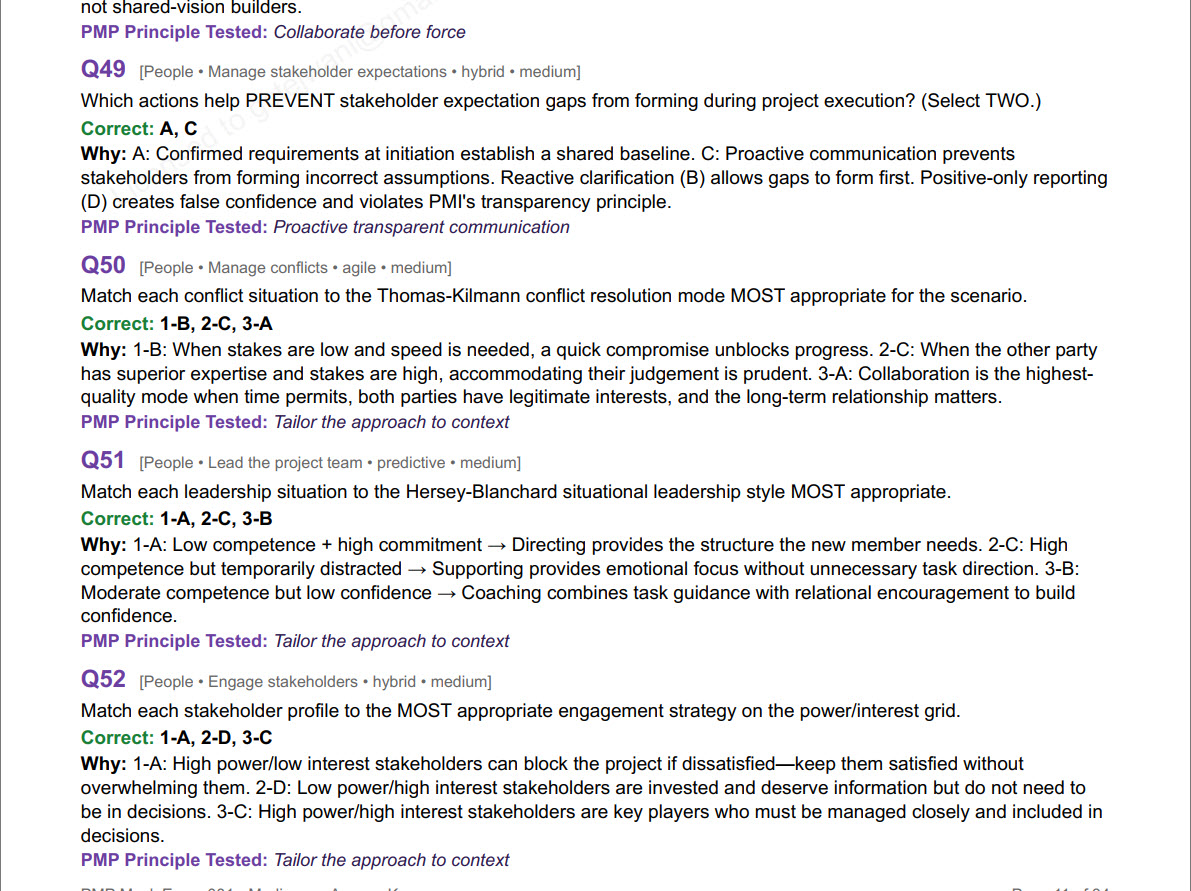
Here's the part no outline fully captures: the feel of the questions. PMP questions are overwhelmingly situational. You're dropped into a scenario and asked for the best next action. Often, two or three answers are technically acceptable — but only one reflects the PMI mindset.
That mindset runs through almost the entire exam. In practice it tends to mean:
- Act as a servant leader: support and empower the team rather than command it.
- Be proactive: prevent problems instead of reacting to them.
- Talk to people directly before escalating or going around them.
- Protect the team's ability to deliver value.
When you practise PMP questions, you're really training yourself to spot which option a thoughtful, people-first project manager would choose. That's a skill you build through repetition and review, not something you can cram the night before.
Why outdated "dumps" are dangerous
Because the exam feels hard, some candidates reach for shortcuts — recycled question "dumps" and memorised answer banks. It's worth being clear-eyed about why that's risky:
- They're often out of date. Many were written for older ECO versions, with the wrong domain emphasis and outdated assumptions.
- They teach the wrong skill. Memorising answers does nothing to build the judgement the real exam rewards. On exam day, the scenarios won't match.
- They conflict with PMI's standards. Beyond the ethics issue, they simply don't reflect how the current exam thinks.
The exam tests mindset, not memory. A genuine, well-explained PMP mock exam will always serve you better than a list of "real questions," because it trains the reasoning you'll actually need.
How to prepare for the 2026 PMP exam pattern
Knowing the pattern is only useful if it changes how you study. Here's a practical approach:
- Use material aligned to the 2026 ECO. Confirm your prep resources reflect the current domains and weightings, including agile and hybrid coverage.
- Weight your study like the exam. Spend most of your time on People and Process. Don't over-invest in the small Business Environment domain.
- Practise across all three approaches. Make sure your PMP practice questions include predictive, agile, and hybrid scenarios.
- Tag every practice question. After each one, note which domain and which principle it tested. Over time you'll see your own pattern of strengths and gaps.
- Use full-length mock exams. Complete, timed exams naturally mirror the real domain mix, so your practice scores actually mean something.
The cost of preparing for the wrong exam
It's easy to underestimate how much misaligned preparation costs. A PMP attempt represents real money plus weeks or months of effort. Candidates who study an outdated or unbalanced version of the exam often feel confident right up until they sit the real thing — and then the unfamiliar emphasis on agile, hybrid, and people-leadership scenarios catches them off guard.
Aligning to the current ECO and practising realistic, scenario-based questions is how you avoid that gap. It turns "I hope I studied the right things" into "I've seen this pattern before."
See the real pattern for yourself
The fastest way to understand the 2026 PMP exam pattern is to experience it — a full-length, scenario-based paper that mirrors the real domain mix.
Try it free. Download a complete, 2026-aligned PMP mock exam at no cost → — 180 scenario-based questions with detailed rationales, so you can feel the real pattern instead of reading about it.
Want to prepare for every part of the blueprint? Get 35 full-length PMP mock exams (6,300+ questions) aligned to the 2026 ECO → — covering People, Process, and Business Environment across predictive, agile, and hybrid scenarios, with explanations, analytics, and lifetime access.
Understand the blueprint, weight your study to match it, and practise the way the exam actually thinks. Do that, and the 2026 PMP exam pattern stops being a source of anxiety and becomes something you've already rehearsed.