How Many PMP Practice Questions Do You Really Need to Pass? (2026 Guide)

TechNet Consultancy
6/24/2026
#PMP#PMP Practice Questions#PMP Mock Exam#PMP Exam Preparation#Project Management

If you've started preparing for the PMP exam, one practical question tends to surface again and again: how many PMP practice questions do I actually need before I'm ready to sit the exam?
It's a fair question, and an important one. The PMP exam is not a test you can comfortably read your way through. It is a test of judgement applied under time pressure. And the most reliable way to build that judgement is through realistic PMP practice questions, full-length mock exams, and honest review of your answers.
But the honest answer isn't a single number. Anyone who promises you "do exactly X questions and you'll pass" is overselling. What actually matters is reaching a point of consistent performance across all PMP domains, with strong time management and genuine confidence. This guide walks through how to think about that — realistically, without hype — so you can plan your PMP exam preparation with clarity.
Why the PMP exam rewards practice, not just reading
Many PMP candidates discover that understanding the concepts is only part of the challenge. You can read the PMBOK® Guide cover to cover, understand every process, and still feel blindsided on exam day. Why? Because the real exam rarely asks you to define a concept. It asks what you would do.
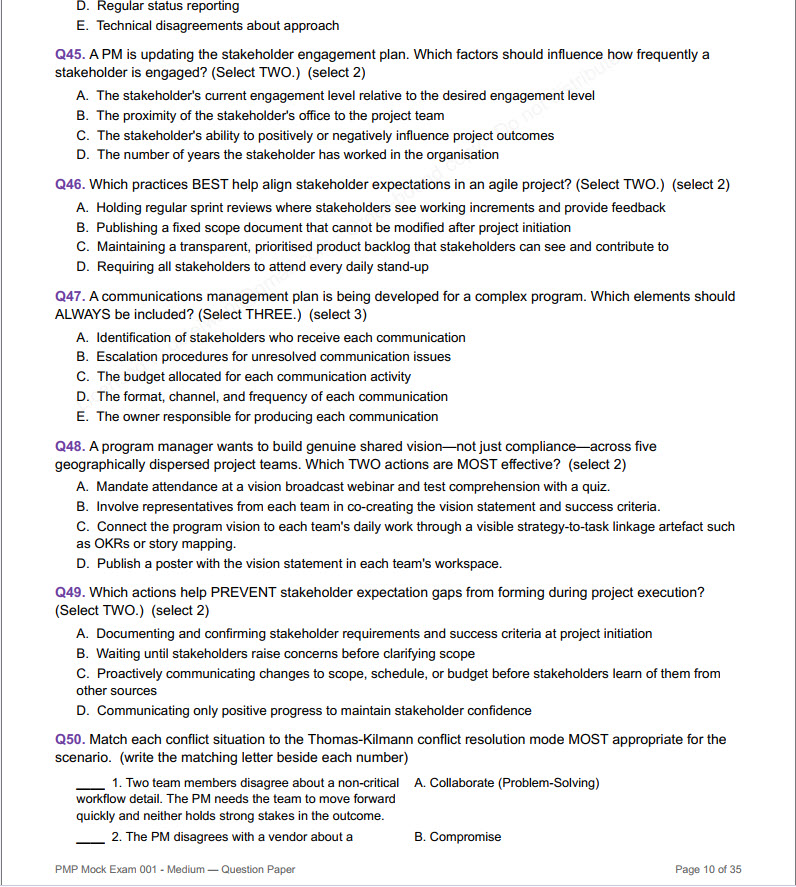
A typical PMP exam question puts you inside a situation: a stakeholder is unhappy, a sprint is slipping, two team members are in conflict, a sponsor wants a scope change late in delivery. You're asked what to do first, or what the best response is. Several answers look reasonable. Only one reflects the way the Project Management Institute (PMI) expects a project manager to think.
Applying PMI's mindset consistently, under exam conditions, requires significant practice. That's the core reason PMP practice questions and mock exams matter so much. They train the pattern recognition that reading alone cannot.
How many PMP practice questions are enough? A realistic view
There is no universal magic number. Some candidates feel ready after around 1,500 questions; others need 4,000 or more. Your starting knowledge, your experience as a project manager, and how carefully you review your mistakes all change the math.
Rather than chasing a single figure, it helps to think in stages of readiness. Many successful PMP candidates describe a journey that looks something like this:
- Foundation (roughly 500–1,000 questions). You learn the question format, get comfortable with scenario-based phrasing, and connect concepts you studied to how they actually appear on the exam.
- Confidence building (roughly 1,500–3,000 questions). Patterns start to emerge. You begin recognising the PMI mindset more quickly and start to see why the best answer is best, not just that it is.
- Exam readiness (roughly 3,000–5,000+ questions). Your scores stabilise. You manage time better, second-guess yourself less, and your weak domains become noticeably stronger.
- Mastery and retake insurance (6,000+ questions). This is the "I'd rather over-prepare than wonder" tier — broad exposure across every domain, deep familiarity with question styles, and the calm that comes from having seen it all before.
Notice that this is framed as a range, not a promise. Many candidates report that after several thousand realistic practice questions, they begin recognising PMI patterns much faster and make better decisions under time pressure. That's a believable, repeatable experience — not a guarantee, but a strong trend.
Why volume only works with honest review
Here's the part that's easy to miss: doing thousands of questions changes nothing if you don't review them properly. Volume without reflection just reinforces the same mistakes faster.
After every PMP practice test, slow down and ask three questions:
- Why was my answer wrong?
- Why was the correct answer better?
- Which PMI principle or domain was this question really testing?
This review loop is where the actual learning happens. A question you got wrong and then understood deeply is worth more than ten questions you rushed through. This is also why the quality of explanations matters as much as the quantity of questions. A good PMP exam simulator doesn't just tell you the right answer — it explains the reasoning, so each question teaches you something you can reuse.
Why one mock exam is never enough
A single full-length mock exam is useful — it gives you a snapshot. But a snapshot isn't preparation. The PMP exam is 180 questions over 230 minutes. That's closer to a marathon than a sprint, and stamina is a real factor. Concentration drifts, reading slows, and small mistakes creep in during the final stretch.
Full-length PMP mock exams train you for exactly that. You're not only practising questions; you're practising endurance, pacing, and decision-making when you're tired. The more complete, timed exams you take, the less the real thing surprises you.
The cost of being under-prepared
It's worth being honest about what's at stake, because it shapes how seriously you take practice.
A PMP exam attempt costs real money, and behind that fee sits weeks or months of study and the opportunity cost of your time. Candidates who rely only on reading frequently discover that the actual exam feels very different from what they expected — the phrasing, the ambiguity, the pace. That gap between "I understood the material" and "I performed under exam conditions" is where many first attempts are lost.
Practice exams exist to close that gap. They reduce surprises, sharpen time management, and reveal weak areas while you still have time to fix them. Think of mock exams less as extra studying and more as a rehearsal for the real performance. The goal isn't to collect questions; it's to walk in without unknowns.
A simple way to know you're ready
Instead of asking "have I done enough questions?", ask better questions:
- Am I scoring consistently across all PMP domains, not just my strong ones?
- Can I finish a full 180-question exam within the time limit without rushing the last 30?
- When I get a question wrong, can I usually explain why — and would I get a similar one right next time?
- Do I feel calm with scenario-based, judgement questions rather than thrown by them?
When the answer to those is consistently yes, you're ready — whether that took you 2,000 questions or 5,000.
How to practise the smart way
If you want a simple plan to put this into action:
- Start with one full, untimed mock to set an honest baseline and learn the format.
- Review every explanation — including the questions you got right (you may have guessed).
- Use your results to find your two weakest domains, and drill those deliberately.
- Move to timed, full-length exams to build stamina and pacing.
- Repeat until your scores are consistent and your time management is comfortable.
Start practising today
If you'd rather over-prepare than wonder whether you've done enough, extensive, well-reviewed mock exam practice is usually the safest strategy — especially if your goal is to pass on the first attempt and avoid the cost of a retake.
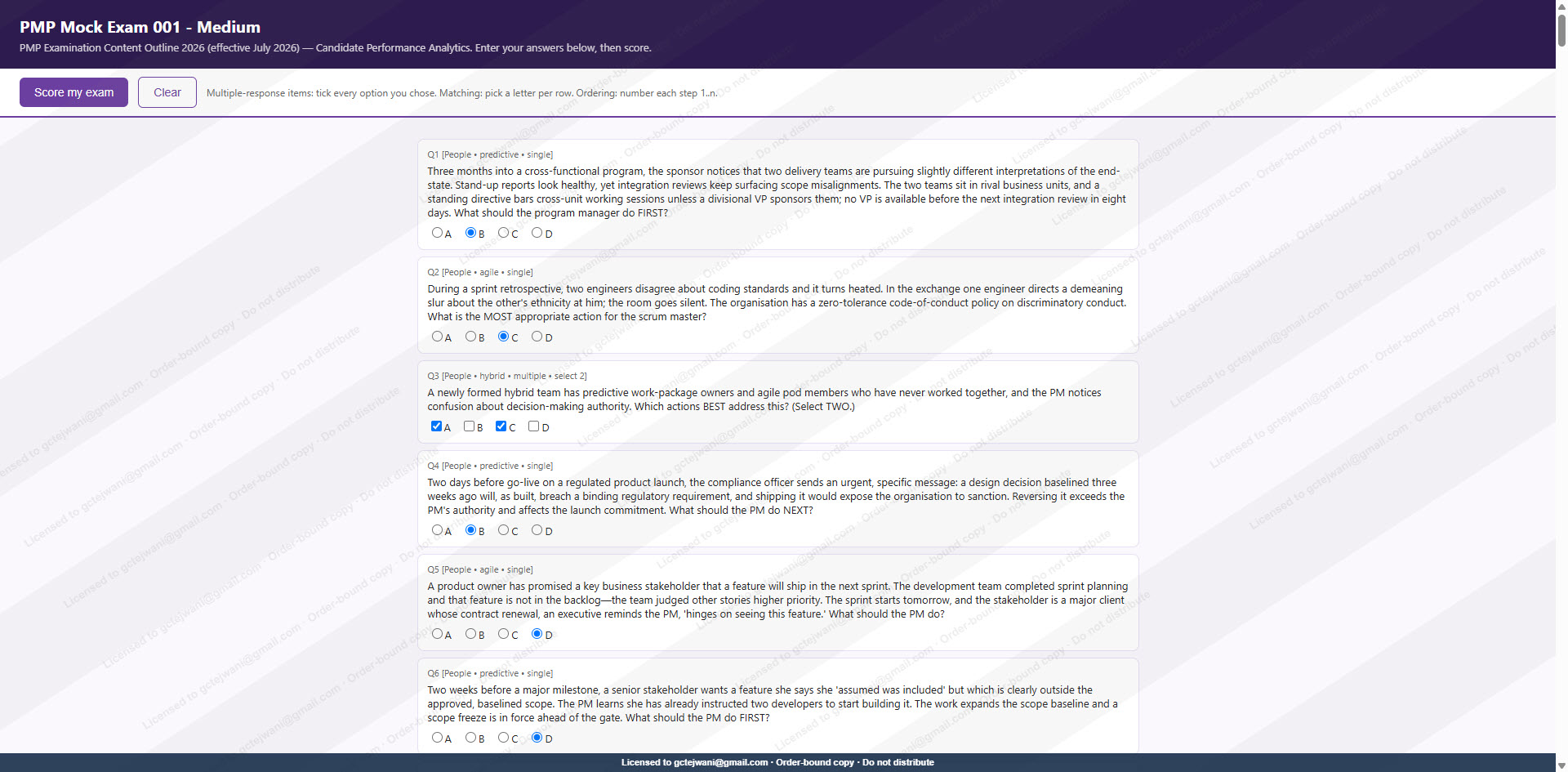
See the quality for yourself, free. Download a complete PMP mock exam at no cost → — a full 180-question paper with detailed explanations and an interactive score report, so you can judge the standard before you commit.
If your goal is to pass on the first attempt, don't stop after one or two mocks. Build genuine exam-day confidence with 35 full-length PMP mock exams (6,300+ realistic questions) → — detailed explanations, domain-wise performance analytics, and lifetime access. It's built to take you through every readiness stage above, right up to mastery.
There's no magic number of PMP practice questions. But there is a clear path: practise realistic questions, review them honestly, build stamina with full-length mocks, and keep going until your performance is consistent across the board. Do that, and the number takes care of itself.