Your 30-Day PMP Study Plan Using Mock Exams (Built for Busy Professionals)
TechNet Consultancy
7/7/2026
#PMP#PMP Study Plan#PMP Mock Exam#PMP Exam Preparation#Project Management

Most people preparing for the PMP exam are working professionals. You have a job, responsibilities outside work, and a limited number of focused study hours each week. You don't need a sprawling six-month plan — you need a focused one that uses your time well.
This is a practical 30-day PMP study plan built around the single highest-leverage activity in PMP exam preparation: full-length mock exams paired with honest review. It assumes you already understand the fundamentals and now want to convert that knowledge into consistent, exam-ready performance. If you're starting from zero, you may need longer — and that's completely fine. Use this as the final, intensive phase of your preparation.
A quick, honest note before we start: 30 days is realistic for many candidates, but it isn't a guarantee for everyone. Your starting point, your available hours, and how disciplined you are about review all matter. Treat this as a proven structure to adapt, not a magic countdown.
The one principle that holds the whole plan together
Before the day-by-day, internalise this: practise full-length, review honestly, repeat. Everything below is just a schedule for doing that consistently. Your mock exam score report is your map — it tells you exactly where your judgement is weak, so you can study your gaps instead of re-reading what you already know.
Reading refreshes knowledge. Mock exams build performance. In these final 30 days, performance is what you're optimising for.
Week 1 — Baseline and the People domain
Your first job is to find out where you actually stand, not where you think you stand.
- Day 1: Take one full-length mock exam, untimed. Don't worry about the score — this is your honest baseline.
- Days 2–3: Review that entire exam, every single question, including the ones you got right. For each, note the domain and the principle being tested.
- Days 4–7: Focus your study on the People domain (around 42% of the exam) — conflict, team performance, stakeholder engagement, servant leadership. Take two or three more exams across the week and keep reviewing rationales.
The People domain is where many technically strong candidates quietly lose marks, so starting here is deliberate.
Week 2 — Process domain and building stamina
- Days 8–11: Shift focus to the Process domain (around 50% of the exam). Make sure you're practising predictive, agile, and hybrid scenarios, because the real exam blends all three.
- Days 12–14: Begin taking timed full-length exams. This is where stamina training starts. Sit them in one go, the way you'll sit the real exam, so you get used to staying sharp across 180 questions.
Keep a running list of recurring mistakes and the principle behind each. Patterns in your errors are gold — they point straight at what to fix.
Week 3 — Business Environment and your weak areas
- Days 15–16: Cover the Business Environment domain (around 8%). It's small, so don't over-invest — a focused pass is enough.
- Days 17–21: This is targeted-repair week. Use your score reports to identify your two weakest areas and drill them deliberately. Alternate timed full-length exams with focused review days so you're both building stamina and closing gaps.
By the end of week 3, your scores should be noticeably steadier and your weak domains noticeably stronger.
Week 4 — Simulate exam day and taper
- Days 22–27: Take full-length, timed mocks under exam-like conditions — quiet room, no interruptions, only the real breaks. Review only what you get wrong; you're polishing now, not learning new material.
- Days 28–29: Light review of your error log and key concepts. No heavy new study.
- Day 30: Rest. Trust your preparation. Walking in calm and well-rested is worth more than a few extra cramming hours.
How many questions will this take?
People often ask how many practice questions a plan like this involves. There's no magic number — some candidates feel ready after around 1,500 questions, others need 4,000 or more. Across 30 focused days of full-length exams plus targeted drilling, many candidates work through a substantial volume, and that's the point: broad, repeated exposure is what makes your performance consistent.
The real goal isn't hitting a question count. It's reaching consistent scores across all domains, comfortable time management, and the quiet confidence that comes from having seen the patterns many times. If you'd rather over-prepare than wonder whether you've done enough, a large bank of full-length mocks gives you room to keep practising until you're genuinely ready — which is exactly why having many exams on hand matters more than racing through a fixed list.
Adapt the plan to your reality
This is a framework, not a cage. A few sensible adjustments:
- Less time per day? Stretch the plan to 6–8 weeks and keep the same sequence.
- Strong in People, weak in Process? Rebalance the weeks toward your actual gaps — the score report tells you where.
- Scores still inconsistent in week 4? Don't force the exam date. A steady 80%+ across domains is a far better signal than a calendar.
The structure stays the same; the pace flexes to fit your life.
The cost of skipping the rehearsal
It's worth remembering why this matters. A PMP attempt costs real money and represents weeks of effort. Candidates who prepare by reading alone often feel ready — until the length, pacing, and ambiguity of the real exam catch them off guard. A retake means another fee, more study, and a delayed certification.
A plan built around full-length mock exams is, in effect, a series of dress rehearsals. By exam day, nothing about the format surprises you. That's the entire value: you've already performed this, many times, before it counted.
Start your 30 days today
The best time to set your baseline is now — one full-length exam tells you exactly where you're starting from.
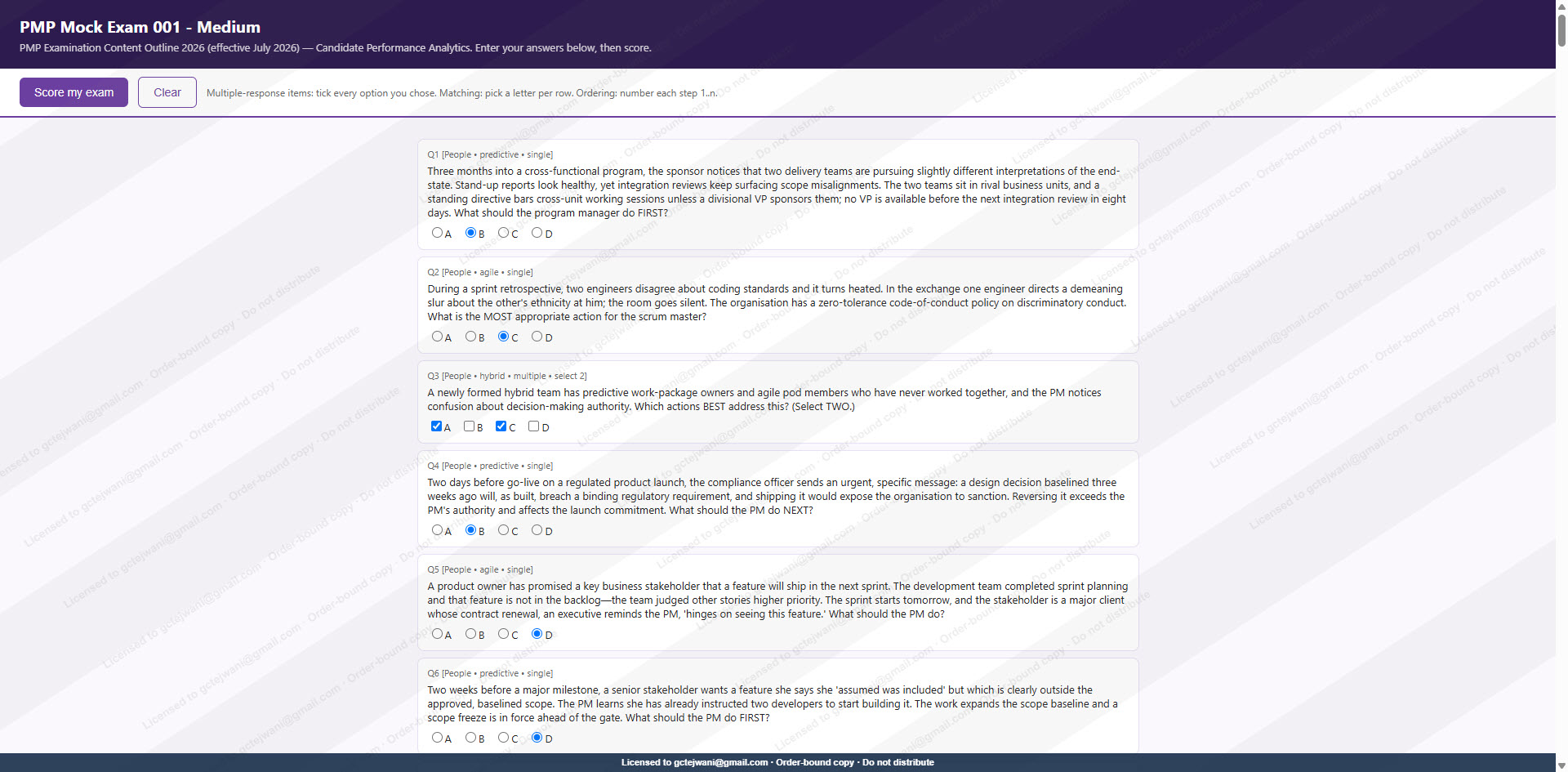
Begin for free. Download a complete PMP mock exam with an interactive score report → and take it as your Day 1 baseline.
Run the full 30-day plan with room to spare. If your goal is to pass on the first attempt, give yourself enough realistic practice with 35 full-length PMP mock exams (6,300+ questions) → — detailed explanations, domain-wise analytics to target your weak areas, and lifetime access, so you can practise on your own schedule until you're consistently exam-ready.
Thirty focused days, built around realistic practice and honest review, is enough for many candidates to walk in confident. Set your baseline tonight, follow the sequence, and let your score report — not your nerves — tell you when you're ready.